Choose a camp kitchen organizer by how you want to find your tools at dinner. The Kelty Camp Galley Deluxe opens into a hanging pocket layout, while the Kelty Window Seat keeps equipment in a lidded storage cube with a divider; one emphasizes display and access, the other a contained carry-and-store routine.
We checked the exact listings and Kelty documentation on October 20, 2026, without conducting packing, weather, or durability tests. Both can help organize a small kitchen, but neither is a universal replacement for approved food storage, protected knife handling, or the transport instructions for fuel and cooking equipment.
Choose between an open wall and a closed box
Lay out the small tools you actually use for a weekend's meals before selecting an organizer. Count the utensils, board, towels, and cleaning items that need a predictable place, then separate anything that requires its own protective case or storage arrangement.
Ask whether you want to see tools at once or carry them in one contained package. A hanging layout may make individual pockets easy to scan, while a cube may be simpler when the kit moves repeatedly between the car, a food locker, and the picnic table.
The exact products here are Camp Galley Deluxe, ASIN B096SZB1WY, and Window Seat, ASIN B096SW7JF1. We are not treating the smaller standard Camp Galley, other Kelty storage products, or a similarly colored duffel as equivalent packages.
We considered access, attachment needs, bulk, separation, and reset after washing. We did not assign a numerical capacity score, because a listed volume cannot tell you whether a particular pan handle, cutting board, or protected knife fits the usable interior shape.
If an existing tub already carries your complete kitchen comfortably, try dividing and labeling it before replacing it. A specialized organizer earns its place when it fixes a specific retrieval or packing problem that the simpler arrangement still leaves unresolved.

Kelty Camp Galley Deluxe: for visible pocket storage
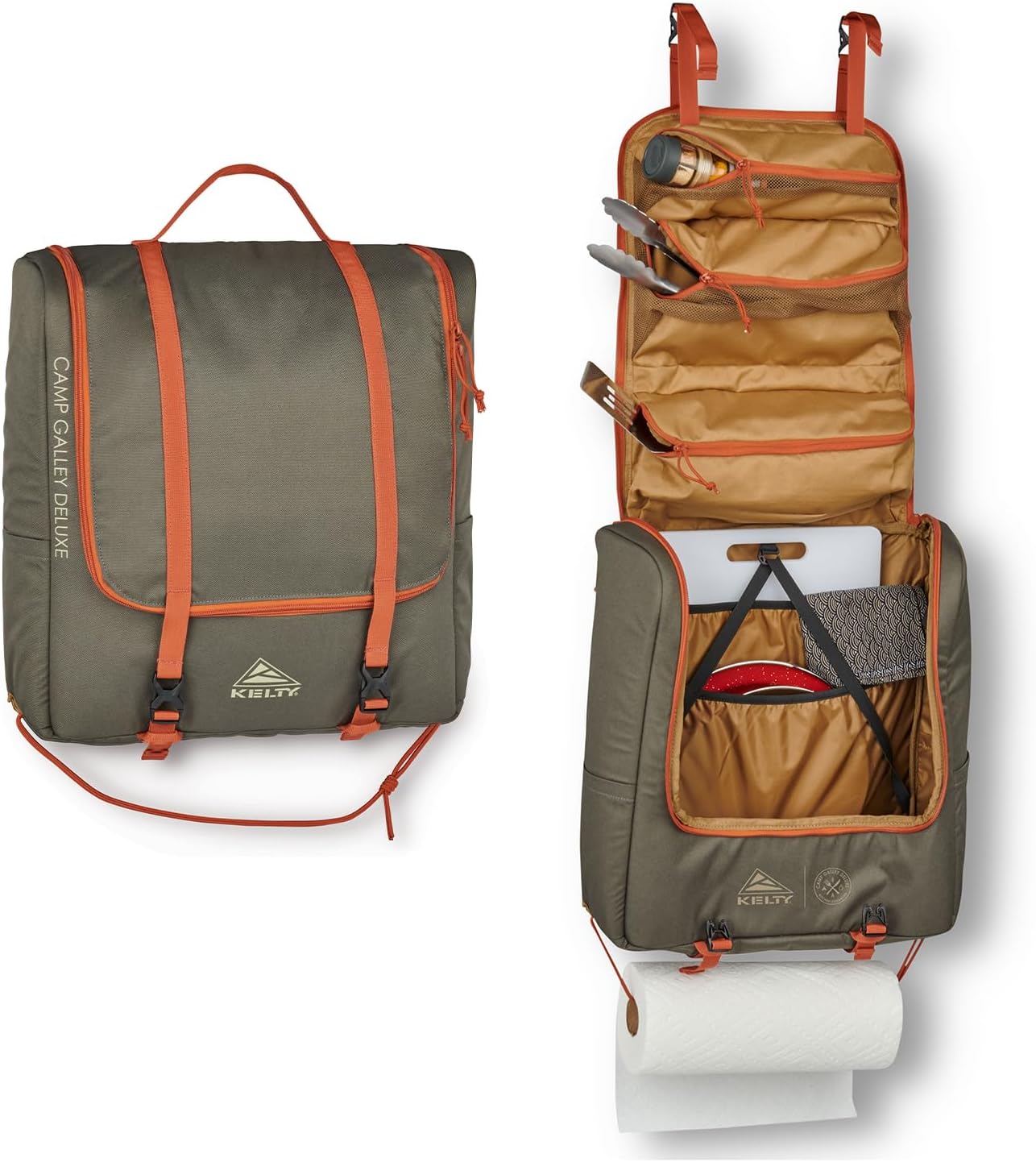
Exact model documentation: Manufacturer specifications and instructions. Listing checked October 20, 2026.
Kelty describes the Camp Galley Deluxe as a structured kitchen organizer designed for hanging or laying flat in use. Its documented layout includes three upper zippered pockets, lower sleeves, side pockets for longer tools, and a paper-towel holder that can also serve as a small drying line.
Choose it when several small tools benefit from individual visible locations. You can assign a pocket to preparation tools and another to serving items, making it easier for a companion to help without opening a deep bin and moving everything on top.
Before relying on a hanging arrangement, confirm a permitted, suitable support and follow attachment instructions. A branch, roof rack, or campsite fixture appearing in a photograph does not establish that your own support can carry the loaded organizer or may be used that way.
Manufacturer and marketplace dimensions differ in presentation and values, so this guide does not combine them into a precise packed-fit promise. Measure your longest equipment and check the exact package information or ask Kelty before buying for a tight storage opening.
Skip the Deluxe if you do not have a workable place to deploy its open layout, or if most of your kit consists of bulky cookware rather than pocket-sized tools. A wall of compartments can add complexity when your menu needs only a few easily gathered utensils.
Kelty Window Seat: for a contained kitchen cube

Exact model documentation: Manufacturer specifications and instructions. Listing checked October 20, 2026.
The checked Window Seat listing identifies a 28-liter cube with a clear lid, adjustable removable divider, and carry handles. Its listed in-use dimensions are 15 by 12 by 12 inches, so the organizing shape is a box rather than a hanging panel of individual sleeves.
Choose it when you want to move a contained kit between locations and keep the general contents visible through the lid. The divider can separate groups of equipment, but you still need appropriate protection for sharp objects and secure storage for anything that could leak.
A cube asks you to manage depth as well as volume. Put frequently used tools in accessible groups instead of stacking every small item below a large pot, or you may reproduce the rummaging problem you hoped the new organizer would solve.
The clear lid helps you see the arrangement, but it does not turn the cube into a food-safe cooler, wildlife-resistant container, or a waterproof promise. Follow the product instructions and the campsite's rules for food, scented items, and dirty equipment.
Skip the Window Seat if you specifically want tools displayed vertically throughout cooking. It may fit your transport routine well while still occupying more table area than you want once its contents are open and the lid needs somewhere to go.

Plan the kitchen around where the kit must go
Check local storage rules before deciding where either organizer will stay overnight. Yosemite, for example, includes scented items and unwashed meal equipment in its food-storage guidance, so a convenient organizer hanging beside the tent is not automatically an acceptable endpoint.
Make the required storage move part of the comparison. If you need to gather the kitchen into a locker after each meal, consider how easily the deployed organizer closes and whether the complete package fits the available space.
Keep cleaning products secure and away from food-contact equipment according to their labels. A separate pouch or container can preserve a clear boundary without relying on a fabric pocket to contain every possible leak or spilled residue.
Pack knives and other sharp tools with appropriate covers and predictable placement. Do not use an organizer's soft material as the sole protection between a blade and the hand reaching into the next compartment after dark.
Store fuel and hot equipment according to their own instructions rather than an organizer's marketing photograph. Let cookware cool appropriately, and avoid treating a convenient empty pocket as proof that a particular cylinder or connected stove belongs inside it.
Test access before adding more compartments
Use a paper or cardboard outline of the intended organizer shape and place your tools within it. You will quickly see whether the main problem is a long handle, a broad board, an awkward pan, or simply too many duplicate utensils.
Then rehearse one meal with tools grouped by task. Keep preparation items together, give used utensils a separate collection place, and see whether you can return clean items without repeatedly reorganizing the entire kit.
Ask someone else to find the opener, towel, and serving spoon without coaching. Visible pockets help only when their contents make sense to the group, and a clear-lidded cube helps only when the arrangement beneath it remains understandable.
Check carrying comfort with the load you expect, within the product's instructions and limits. A well-organized container can still be awkward if its size requires two hands while you are also trying to manage a cooler or protect bedding from rain.
Consider the table area left after deployment. If an organizer consumes the preparation surface or blocks a walking route, rearrange the camp or choose another format rather than measuring success by how many pockets you managed to fill.
Finish with a repeatable reset
Pick Camp Galley Deluxe when a deployed pocket layout and a suitable attachment or flat-use position make tools easier to find. Pick Window Seat when a contained cube, divider, and clear lid better support carrying and storing your kit between meals.
Choose neither if you need rigid impact protection, a cooler, a certified wildlife-resistant container, or a dedicated cookware case. Those are different jobs, and neither an attractive fabric panel nor a large volume claim proves the required capability.
After a trip, empty the organizer, clean it as directed, and allow it and the equipment to dry appropriately before storage. Replace depleted supplies from a short contents list instead of leaving damp towels and half-used cleaning items sealed until the next weekend.
The best organizer makes a familiar sequence easy to repeat: take out the right tools, finish dinner, clean up, and put the kit where it belongs. Choose the format that supports that sequence for your campground, with fewer searches and a clearer place for each item.
Sources & research notes
Exact pages inspected October 20, 2026. Original planning examples are editorial suggestions; no hands-on testing is claimed.
- Kelty Camp Galley Deluxe documented model, construction, dimensions/features and constraints; no owner-test claims
- Kelty Camp Galley Deluxe exact selected package and primary image; listing-specific fields
- Kelty Window Seat28L documented model, construction, dimensions/features and constraints; no owner-test claims
- Kelty Window Seat28L exact selected package and primary image; listing-specific fields
- Yosemite food-storage example includes scented items and dirty cookware